
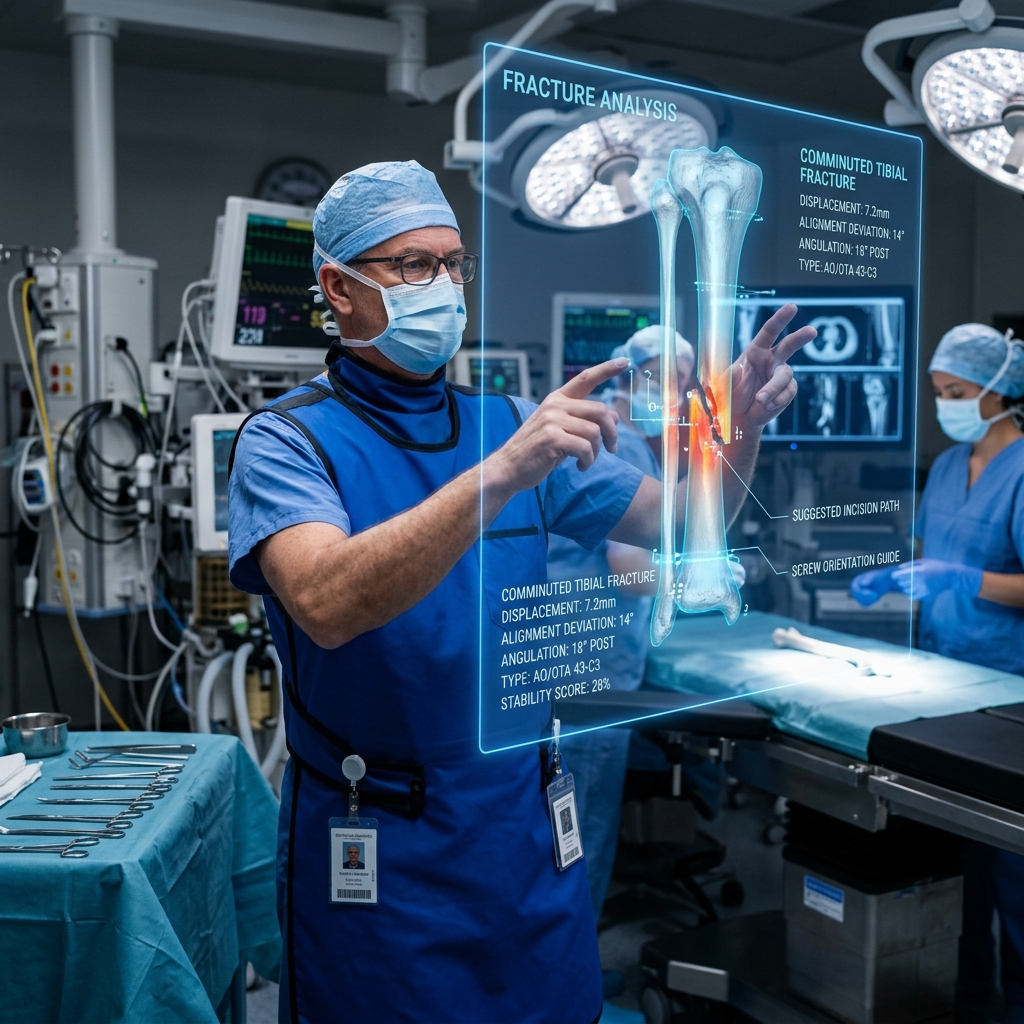
Orthopedic conditions affect virtually everyone at some point in life — from childhood fractures to age-related joint degeneration. Artificial intelligence is now transforming every aspect of orthopedic care, from the moment an X-ray is taken to the precision of robotic-assisted surgeries.
AI Fracture Detection
Missed fractures account for a significant portion of diagnostic errors in emergency departments. AI systems analyzing X-rays now achieve 95%+ accuracy in fracture detection, catching subtle breaks that human eyes can miss, especially in busy ER environments. These systems work in seconds and can flag suspicious images for immediate radiologist review.
Beyond Simple Fractures
AI orthopedic imaging doesn't stop at fractures. Advanced algorithms can identify:
- Osteoarthritis severity grading from knee and hip X-rays
- Stress fractures invisible on standard X-rays (detected via MRI patterns)
- Joint space narrowing progression prediction
- Bone age estimation for pediatric growth assessment
- Bone tumor detection and classification
Robotic-Assisted Joint Replacement
AI-powered robotic systems are revolutionizing joint replacement surgery. Platforms like MAKO and ROSA use AI to:
- Create 3D surgical plans from CT scans tailored to each patient's anatomy
- Guide bone preparation with sub-millimeter accuracy
- Optimize implant positioning to maximize longevity
- Provide real-time feedback during surgery to prevent errors
Studies show AI-robotic-assisted total knee arthroplasty achieves more accurate implant alignment compared to conventional techniques, leading to better functional outcomes and longer implant survival.
Predictive Osteoporosis Management
AI models analyzing DEXA scans, clinical factors, and even dental X-rays can predict fracture risk in osteoporosis patients with greater accuracy than traditional FRAX scores. These models consider:
- Bone mineral density trends over time
- Microarchitectural bone quality from high-resolution imaging
- Medication history and fall risk factors
- Genetic predisposition to bone fragility
AI in Sports Medicine
Athletes benefit from AI-powered motion analysis that detects biomechanical abnormalities predisposing to injury. AI systems analyze gait, running mechanics, and throwing patterns to identify injury risk before problems occur, enabling preventive interventions.
Ready to take control of your health? Try our AI Doctor today and get personalized medical insights in seconds.